

Older cat losing weight but still eating: the usual causes
Older cat losing weight but still eating? A vet explains the usual causes, how to weigh your cat at home, what the vet checks, and when it can't wait.

Published · 7 min read
Let me guess. Your old girl is yelling for breakfast before the alarm goes off and inspecting your dinner plate like she's from the health department. And yet when you pick her up, she feels lighter. Her backbone is easier to feel than it used to be. So here you are with an older cat losing weight but still eating, wondering if that big appetite means everything's fine.
Take a breath. Let's walk through it the way I would if you were sitting across from me.
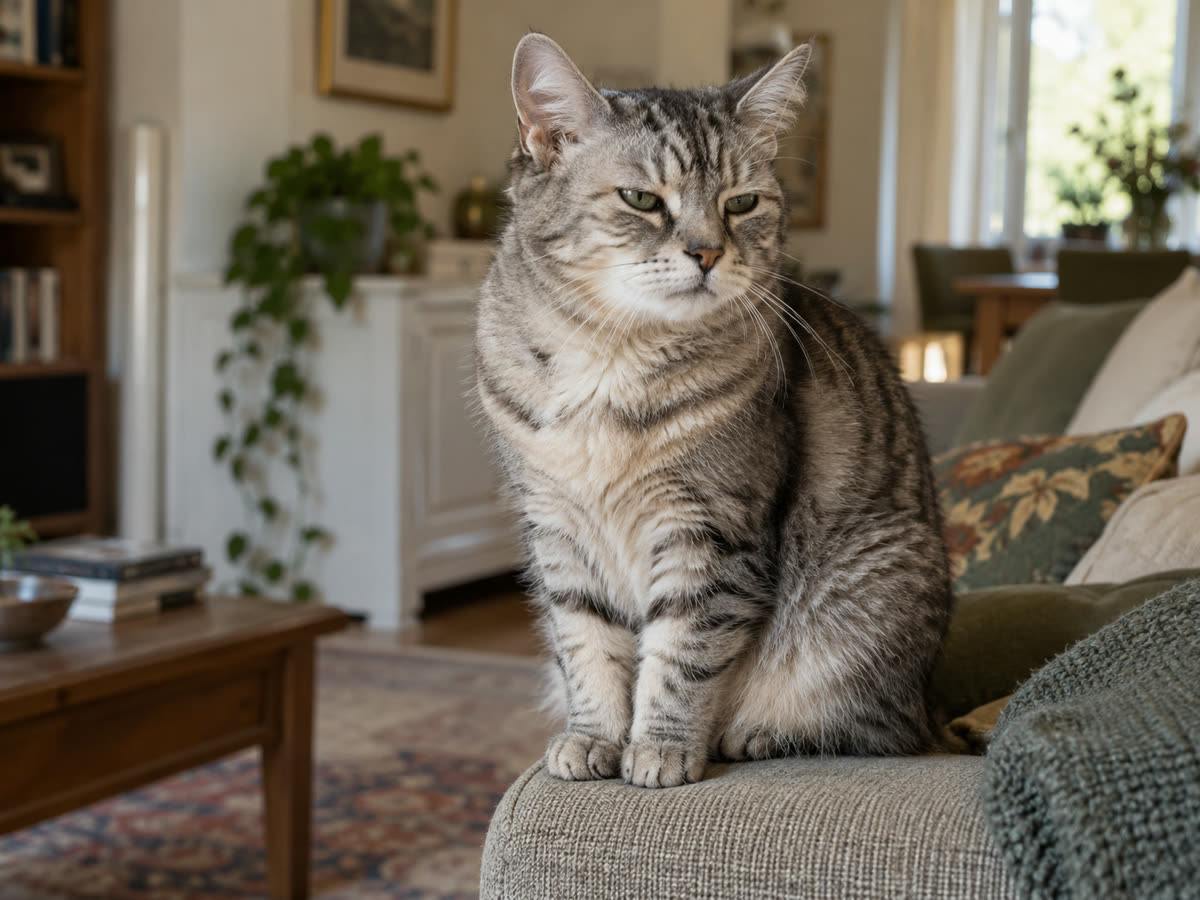
A good appetite doesn't mean she's fine
This is the part that fools people. We see a senior cat cleaning her bowl and acting normal and figure she can't be sick. But when a cat is losing weight, that big appetite doesn't let her off the hook. It's actually one of the clues. The calories are going in, and either something is burning through them or her gut isn't absorbing them.
Here's the thing: cats are good at looking fine. In an older cat, slow weight loss is sometimes the only sign for a while. That's a big reason a senior cat, anything over 10, should have a checkup at least every six months.
And a little math helps. A pound off a 10-pound cat is a tenth of her body weight. On a 150-pound person, that's 15 pounds gone without trying.
The good news: in most cats this is a "book a visit this week" problem, not a "rush to the ER tonight" problem. I'll get to the exceptions at the end.
Why is my older cat losing weight but still eating?
You can't tell these apart at home, and I can't tell by looking at her either. That's what the tests are for.
- An overactive thyroid (hyperthyroidism). In an older cat, it tops my list. The thyroid gland in the neck makes too much hormone, and her whole body runs too fast, like an engine stuck at high idle. The classic cat is hungry all the time and losing weight, drinking and peeing more, and often a bit wired: restless, yowling more, maybe vomiting, with a scruffier coat. In cats it's almost always caused by a growth on the thyroid that isn't cancer. Fewer than 3 in 100 are.
- Diabetes. Without enough insulin, her body can't use the sugar from her food, so it burns fat and muscle instead, and the extra sugar spills into the urine. She eats more, drinks more, leaves bigger clumps in the box, and still gets thinner. It's most common in middle-aged and older cats who carried extra weight.
- Gut trouble. If the intestines aren't absorbing food well, she can eat plenty and still lose. The two big ones in older cats are inflammatory bowel disease (IBD) and a slow form of lymphoma in the intestines. You may see vomiting that's more than the odd hairball, diarrhea, or bigger piles in the box, or just the weight loss. Worms belong here too, and less often, a pancreas that doesn't make enough digestive enzymes.
- Kidney disease. It usually wears the appetite down as it goes, so it doesn't fit "still eating" as neatly. But it's so common in older cats, and so often travels with other problems, that I always check for it.
I know "lymphoma" is a scary word. The low-grade kind in a cat's intestines tends to move slowly. It's still serious, and your vet will walk you through the options.
One more goes at the bottom of the list. Some older cats just don't digest food as well as they used to and need more calories to hold their weight. Your vet only lands there after ruling out the rest, so it's no reason to skip the visit.
And if she's eating less, dropping food or chewing on one side, the list gets longer. Mouth pain goes near the top, but gut, kidney and thyroid trouble can do that too.
How to weigh your cat at home
All you need is a bathroom scale and a cat who'll put up with a hug.
- Weigh yourself and write the number down.
- Pick up your cat and step back on. Write that down too.
- Subtract. The difference is your cat.
- Won't be held? Use her carrier the same way.
- Keep it the same every time: same scale, same time of day, ideally before breakfast.
Bathroom scales miss small changes (a borrowed baby scale does better), so don't panic over one reading. Watch the trend. Once a month is a good rhythm for most healthy seniors; if she's already losing, your vet may want it more often.
Use your hands too. Run them along her back and hips. Bones that are easier to feel, or a narrower face, can tell you something before the scale does. A photo from above and from the side each time you weigh her shows slow changes you'd miss day to day.
If she's drinking more, measure that too. The jug method I use for dogs works for cats.
Write every weight down with the date, on a sheet taped inside a cupboard. "She's down a pound since spring" beats "I think she's thinner" every single time.
Honestly, that's why I built WagNote (full disclosure: it's my app). I kept seeing owners struggle to keep track of slow changes like this from one visit to the next, so I put it all in one place.
What I check at the visit
Bring your weights with you. (Here's my full list of what to bring to the vet.) Here's what I do.
The exam. I weigh her and feel how much fat and muscle she's carrying. I check her neck for an enlarged thyroid, listen to her heart (a racing heart or a murmur can go with an overactive thyroid), feel her belly, and look in her mouth.
Bloodwork with a thyroid test. The thyroid number is called T4. A high T4 in a cat with the right signs answers the question. The same blood panel checks her kidneys, liver and blood sugar.
A urine test. It tells me how well her kidneys are holding on to water, and whether there's sugar or infection. I usually collect it at the clinic, but some vets like a sample from home, caught with a special litter that doesn't soak it up. Ask yours when you book.
A blood pressure check. High blood pressure can come with both thyroid and kidney disease in cats, and it can damage the eyes.
That's my starting point: the exam, bloodwork with a T4, a urine test and blood pressure. Not every vet does all four on the first visit, and there's no wrong way here.
If it's the thyroid, know this going in. An overactive thyroid can hide kidney disease and make the kidney numbers look better than they really are. Once the thyroid is treated, the kidney values in some cats go up, showing disease that was there all along. That's why your vet will recheck her blood, urine and blood pressure after treatment starts.
When the bloodwork comes back normal
This happens. It's frustrating, but it isn't a dead end.
- The thyroid can hide. In about 5 to 10 out of 100 cats with an overactive thyroid, the T4 comes back in the normal range. Your vet may repeat it later, or add a second thyroid test called free T4, which is read alongside the regular T4.
- Gut disease often doesn't show up on routine bloodwork. Sorting it out usually takes other tests: a stool check, an ultrasound of the belly, and blood levels of two vitamins (B12 and folate) that show how well the gut is absorbing. Telling IBD apart from low-grade lymphoma can take biopsies, either through a scope or with surgery.
Which test comes next depends on your cat: her age, her other health problems, what you've seen at home, and honestly what's going on in your household.
When it can't wait
I said I'd get to the exceptions. There are two.
She stops eating. A cat who stops eating can slide into a serious liver problem called fatty liver. It usually starts on top of another illness, like the ones above. Call your vet today. Don't wait to see if it passes.
She seems sick, not just thin. Call your vet or an emergency clinic now if she:
- keeps vomiting or can't keep water down
- is hiding and won't come out, or is very weak or collapses
- is breathing fast or hard, or with her mouth open
- has pale, blue or yellow gums, or yellow eyes
- has a seizure or suddenly seems blind
- has a swollen or painful belly, or black or bloody stool
- suddenly can't use her back legs, or cries out in pain
If you do one thing this week: weigh your cat tonight, the hug-and-subtract way, and write it down with the date, or log it in WagNote. She'll be mildly offended. Your vet will be thrilled.
What to track at home
- Weight On a regular schedule (ask your vet how often), same scale, same time of day. Weigh yourself, then weigh yourself holding her, and subtract. Write it down with the date.
- Appetite How much she eats and whether that has changed. Eating more and still losing weight is a different clue from eating less.
- Water and litter A bowl that empties faster, or bigger and more clumps in the litter box. Measure the water for a full 24 hours if you can.
- Vomiting and stool How often she vomits (hairballs count), and any diarrhea, soft stool or bigger piles. Note the dates.
- Behavior Restless, yowling more, hiding, or sleeping more than usual. Write down when it started.
Questions to ask your vet
- Here are her weights from the last few months. How much has she lost, and how concerned should we be?
- Does her bloodwork include a thyroid test (T4)?
- Do you want a urine sample and a blood pressure check too? How should I get you the urine?
- If the bloodwork comes back normal, what would you check next?
- How often should I weigh her at home, and how much of a drop should make me call you?
When to call your vet
Call your vet and book a visit if your older cat is losing weight, even if she's eating well or eating more than usual. Call too if the weight loss comes with drinking more, bigger litter clumps, vomiting more than the odd hairball, diarrhea, restlessness or yowling, a scruffy coat, or eating less.
If she stops eating, call your vet today. Don't wait to see if it passes.
Call your vet or an emergency clinic now if
Call your vet or an emergency clinic now if your cat has stopped eating and is also vomiting, hiding or weak; keeps vomiting or can't keep water down; is breathing fast or hard, or with her mouth open; has pale, white, blue or yellow gums, or yellow eyes or ear skin; has a seizure; has a swollen or painful belly; passes black, tarry or bloody stool; suddenly can't use her back legs or cries out in pain; is very weak or wobbly or collapses; or suddenly seems blind.
Sources
- Hyperthyroidism in Animals, Merck Veterinary Manual (last updated May 2024)
- 2021 AAHA/AAFP Feline Life Stage Guidelines, Quimby et al., Journal of the American Animal Hospital Association (Mar/Apr 2021)
- Chronic Enteropathies in Small Animals, Merck Veterinary Manual (full review Aug 2025, updated Jun 2026)
- Hepatic Lipidosis, Cornell Feline Health Center
This is general education from a veterinarian, not advice for your pet. I haven't examined your pet, and only your own vet can. If your pet is in distress, call your vet or an emergency clinic now. Medical disclaimer.