

My dog has diabetes: the first two weeks
My dog has diabetes: now what? A vet walks you through the first two weeks: insulin handling, meals and timing, the glucose curve, and low blood sugar.
Published · 7 min read
Let me guess. Your dog has been drinking like he just crossed a desert, peeing like he's trying to give it all back, and eating like every meal might be his last. And somehow he's still getting thinner. Then came the bloodwork, and now you're home with insulin, syringes and a head full of instructions. "My dog has diabetes" is a lot to take in.
Take a breath. Let's walk through it the way I would if you were sitting across from me.
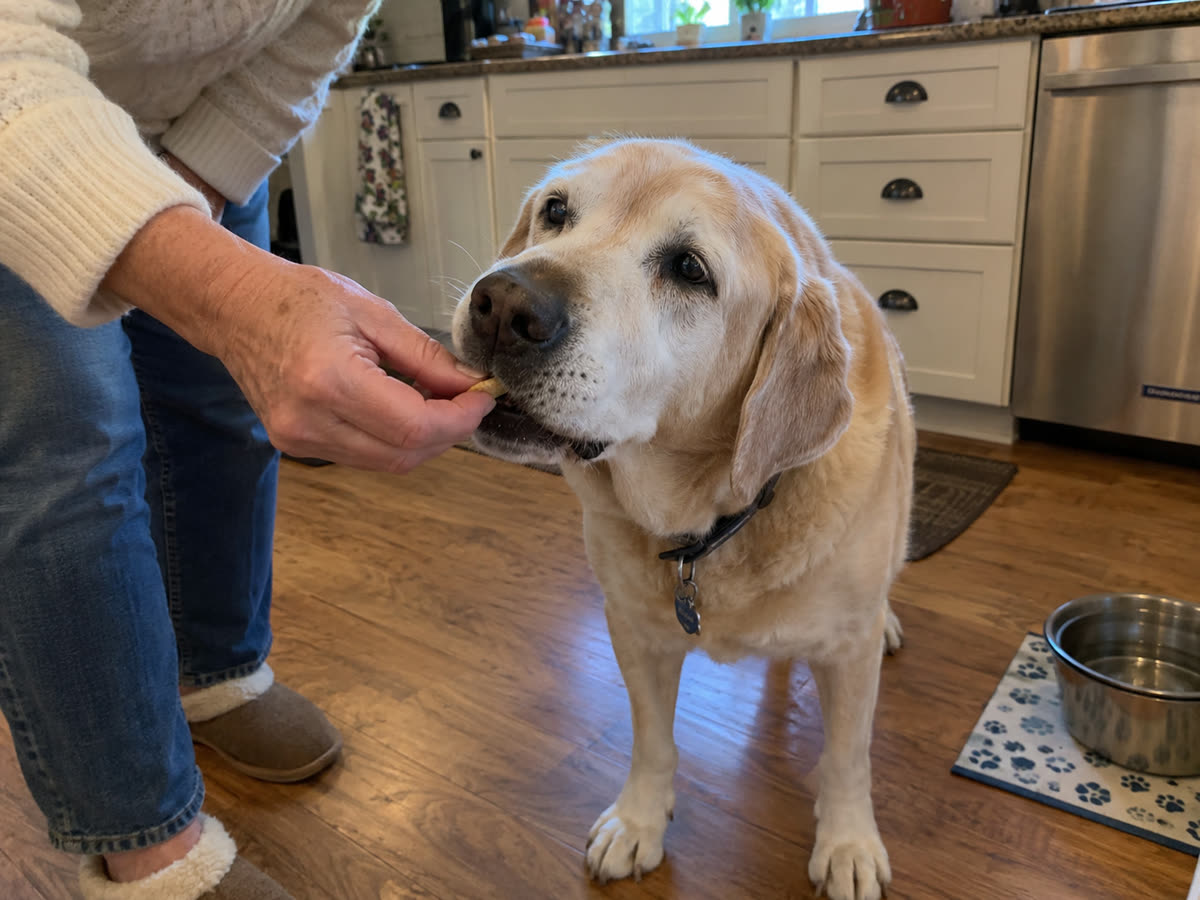
"My dog has diabetes." Now what?
Here's what's going on, in plain words. Insulin is the hormone that lets the body's cells pull sugar out of the blood and use it for fuel. Your dog isn't making enough of it. So the sugar piles up in the blood, spills into the urine, and drags a lot of water out with it. That's the drinking and the peeing. Meanwhile the cells are running on empty, which is why he's hungry all the time and still losing weight.
In dogs, diabetes is usually lifelong, and the insulin shots stand in for what his body isn't making. That sounds like a lot. It's really a routine, and routines get easier.
Here's the thing: the first two weeks aren't about perfect numbers. They're about learning the routine and keeping your dog safe while your vet slowly finds the right amount of insulin. Getting a dog to good control can take anywhere from a few days to a few months. So if things aren't perfect by day 14, that's normal, not a sign that something's wrong.
The insulin schedule: meals and shots run on a clock
Most dogs end up on insulin twice a day, about 12 hours apart, with a meal each time. Some vets start with once a day and add a second shot if the first one doesn't last long enough. Every vet's a little different, and either way is fine.
What matters most is sameness. Same food, same amount, same times, every day. Insulin keeps working for hours whether food shows up or not. When the meals are predictable, the insulin is predictable too. Treats count as food, so ask your vet which ones fit.
Always make sure your dog eats first, then give the insulin. You want to know whether he's going to eat the full meal before that shot goes in. If he walks away from the bowl, you haven't already given a shot that needs food behind it.
What if my dog won't eat?
Call your vet before you give the insulin. Don't guess. Insulin without food can push blood sugar too low, and that's the one thing we work hardest to avoid.
The same goes for half a meal, or a meal that comes back up. Ask your vet now what they want you to do in each case, and write the answer on the fridge, or put it in WagNote so everyone in the house sees the same instructions. And never give extra insulin to make up for a shot you think didn't go in. More insulin is never a home decision.
Shake or roll? Handling the insulin
This one confuses everybody, because the answer depends on the insulin.
- Vetsulin gets shaken. Shake it until it's evenly milky and let any foam settle. If clumps or white bits are still there after shaking, don't use it.
- Many other insulins get rolled gently, never shaken. That includes the human NPH types some dogs are on.
So go by the label on your insulin. If a website and your bottle disagree, the bottle wins.
A few more basics:
- Keep it in the fridge, standing upright for Vetsulin. Never freeze it, and never leave it in a hot car.
- Match the syringe to the insulin. A U-40 insulin like Vetsulin needs U-40 syringes, and a U-100 insulin needs U-100 syringes. The wrong syringe gives the wrong amount, even if you fill it to the right line.
- Use each syringe once.
- Watch the date. Vetsulin should be used up within 42 days of the first time a needle goes into it, so write that date on the box. Better yet, set a reminder for day 42 in WagNote.
Signs of low blood sugar: the one emergency to know
If you remember one section, make it this one. Low blood sugar is the main risk with insulin, and it isn't rare. Plenty of diabetic dogs have at least one low reading along the way, though the signs are usually mild.
Watch for:
- Unusual tiredness or sleepiness
- Weakness, wobbling or stumbling
- Acting strange or confused
- Trembling
- Collapse or a seizure
What to do:
- If your dog is awake and can eat, offer a meal and call your vet.
- If he's wobbly, trembling or not very responsive, rub a little corn syrup or honey on his gums. Don't pour anything into his mouth, because he could choke. Then call and head to your vet or an emergency clinic.
- A seizure, a collapse, or a dog you can't rouse is an emergency. Go now.
Either way, talk to your vet before the next shot is due. And keep the corn syrup or honey right next to the insulin, so you're never hunting for it.
The glucose curve: why one number isn't enough
A single blood sugar reading is a snapshot. A glucose curve is more like a video of one day. The sugar is checked about every 2 hours across the gap between shots, so usually 12 hours. It shows how low the sugar dips and how long the insulin lasts, and those two answers are what your vet uses to adjust the dose.
I usually see a new diabetic dog back in about two to three weeks. That may change, though, and some vets have different things they like to do. Some like to see you at 7 to 14 days, a little sooner than I do. Don't be surprised if the sugar is still high at that visit. The insulin goes up slowly on purpose, because going faster risks the low blood sugar we just talked about. After each dose change, expect another curve a week or two later.
On curve day, feed the normal breakfast and give the normal shot at the normal time, unless your vet says otherwise. If your dog won't eat that morning, call the clinic first. Stress can also push blood sugar up, which is one reason curves done at home are often more accurate.
Given the choice, I'd go with a stick-on glucose sensor. It reads the sugar around the clock for about two weeks. I use the FreeStyle Libre. There are others, but the Libre is the one vets use most. Why a sensor? Your dog is at home and more comfortable, and he isn't getting stuck every two hours for a glucose curve.
The catch: these sensors are made for people, and sometimes they don't stick as well as we'd like. In cats they can be a little more difficult and finicky. Still, even a few days of sensor data usually tells me more than a single curve.
Your vet may also run a blood test called fructosamine. If the curve is a video of one day, fructosamine is more like the average of the last week or two. It's handy for spotting the trend between rechecks.
Between twice-daily shots, meals on the clock and rechecks every few weeks, there's a lot to keep straight. Honestly, that's why I built WagNote (full disclosure: it's my app). I kept seeing owners struggle to keep track of everything with conditions like this, so I put it all in one place.
If the numbers won't settle
Some dogs take longer. If the sugar stays stubbornly high over the coming weeks, your vet may look for something else that makes insulin work poorly. In dogs, the classic one is Cushing's disease (here's how I work up Cushing's). And a female who isn't spayed will usually need to be, because her heat-cycle hormones work against the insulin.
What to watch at home
The curve matters, but the signs you see at home matter more. Here's what to track:
- Meals and shots. Every meal and whether he finished it, plus the time of every shot and the initials of whoever gave it. Two people, one dog and no checklist is an easy way to end up with a double dose.
- Water. Fill a big jug in the morning, fill the bowl only from that jug for 24 hours, and see how much is gone. Write it down with the date, or log it in WagNote's water tracker so you can watch the trend (more on measuring water). Coming down over the weeks is what we want.
- Weight. Once a week, same scale. Steady, or slowly climbing back, is a good sign.
- Energy. More like his old self is good. Unusually sleepy or wobbly can mean low blood sugar, so go back to that section.
If you do one thing this week: keep track of every meal and every shot, with the time. Tape a sheet to the fridge, or just get WagNote and tap each dose as it's given, so the whole house knows nobody doubled up. (Your dog already thinks the fridge is the most important thing in the house. He's not wrong.)
What to track at home
- Meals Did your dog eat the whole meal? Write it down every time. A skipped or half-eaten meal is a call to your vet before the insulin.
- Insulin shots The time of each shot and who gave it. A check-off sheet stops two people from both giving it.
- Water Measure a full 24 hours with a jug and write the number down with the date. Coming down over the weeks is what we want to see.
- Weight Once a week, same scale. Steady or slowly climbing back is a good sign.
- Energy Unusually sleepy, weak or wobbly can mean low blood sugar. See the Call now box.
Questions to ask your vet
- Once my dog has eaten, how soon should the insulin go in?
- What do you want me to do if my dog eats only half a meal, or vomits?
- How do I mix and store this insulin, and which syringes go with it?
- When is the first glucose curve, and could we do it at home or with a sensor?
- What should make me call you before the next shot?
When to call your vet
Call your vet before giving insulin if your dog skips a meal, eats only part of it, or vomits. Don't guess, and never give extra insulin to make up for anything.
Call too if the drinking and peeing come back, your dog keeps losing weight, the insulin still looks clumpy after mixing, or you're unsure about the schedule. You don't have to wait for the next recheck.
If you accidentally inject yourself, get medical help for yourself right away. The label warns it can lower a person's blood sugar too.
Call your vet or an emergency clinic now if
Call your vet or an emergency clinic now if your dog is weak, wobbly, trembling, confused or unusually sleepy after insulin, collapses, has a seizure, or won't respond. These can be signs of low blood sugar. If your dog is awake but wobbly, rub a little corn syrup or honey on the gums on the way, without pouring anything into the mouth.
Call now too if your dog may have had a double dose or the wrong syringe was used, or is vomiting, refusing food and very weak.
Sources
- 2018 AAHA Diabetes Management Guidelines for Dogs and Cats (with 2022 updates), American Animal Hospital Association
- Vetsulin (porcine insulin zinc suspension): FDA-approved label and Owner Information Sheet, DailyMed (published 23 Sept 2026)
- Diabetes Mellitus in Dogs and Cats, Merck Veterinary Manual (full review May 2024, updated May 2026)
- Continuous Glucose Monitor Use in Small Animal Medicine, Today's Veterinary Practice (Dr. Carly Patterson, Texas A&M, July/August 2026)
This is general education from a veterinarian, not advice for your pet. I haven't examined your pet, and only your own vet can. If your pet is in distress, call your vet or an emergency clinic now. Medical disclaimer.